
Home sales just fell to their lowest level since 2010. Prices did not fall with them. That sounds impossible until you see what happened in the economy this week, and it is exactly what is playing out right now in Calabasas, Hidden Hills, Beverly Hills, and Lake Sherwood.
Luxury is not crashing. A crash is forced selling, distress, and prices dropping because owners have to get out. None of that is in the data. What we have is a freeze: buyers and sellers who both want to move, locked in place by inflation, interest rates, and a Federal Reserve that may raise rates again on December 9.
Before we get into the numbers, one practical note. In a market like this, headlines and list prices tell you very little about your own home. If a move is even on your mind, click What's My Home Worth to find out what your home is worth in today's market, then read the rest of this with that number in hand.
Here is the honest breakdown of the four reports that landed between November 10 and November 13, what the Fed is likely to do next, and what it means if you are thinking about buying or selling this winter.
The short answer
Is the luxury housing market crashing in November 2026? No. Existing home sales fell 5.5 percent in October to a 3.75 million annual rate, the lowest since August 2010, while the median existing home price rose 0.4 percent from a year earlier to $416,700, its 40th straight month of annual gains. Distressed sales were just 2 percent of transactions. Volume collapsed because mortgage rates averaged 7.33 percent in October. Prices held because sellers are not forced to sell and inventory for the right home is still thin.
Report 1: Inflation came in hot, again
On November 10, the Bureau of Labor Statistics reported that consumer prices rose 0.4 percent in October, above the 0.3 percent economists expected. Core prices, which strip out food and energy, rose 0.3 percent, also above forecast, for the third straight month.
Shelter was the story inside the story. The shelter index rose 0.3 percent and accounted for more than 30 percent of the whole monthly increase. In plain English, housing itself is now a major driver of the inflation that is keeping housing expensive.
One unusual note: there is no normal 12 month inflation rate for October this year. The Bureau could not publish it because price data for October 2025 was missed during the government shutdown that fall. The last regular annual reading was 3.7 percent in September. Until the November report arrives on December 10, the monthly numbers carry the story, and they are not gentle.
Report 2: Home sales hit a 16 year low
On November 12, the National Association of Realtors reported that existing home sales fell 5.5 percent in October to a seasonally adjusted annual rate of 3.75 million. That is down 8.8 percent from a year ago and the lowest pace since August 2010.
NAR Chief Economist Lawrence Yun said it plainly: home buying is difficult when mortgage rates have climbed to their highest levels since 2000, aside from a single month in 2023.
Look at what did not happen:
- The median price held at $416,700, up 0.4 percent from a year earlier.
- Inventory rose to 1.59 million homes, or 5.1 months of supply, up from 4.4 months a year earlier.
- Distressed sales stayed at just 2 percent of all sales.
A market where sales fall to a 16 year low and prices still post a gain is not a crashing market. It is a market where almost nobody has to sell, and almost nobody who needs a loan can comfortably buy.
Report 3: Wholesale inflation hit a near four year high
On November 13, producer prices rose 0.3 percent in October and 6.5 percent over the 12 months ended in October. That annual figure is the largest since November 2022.
Producer prices are what businesses pay before goods and services reach you. When they rise at 6.5 percent a year, the pressure does not stay at the factory or the warehouse. It works its way into everything a homeowner pays for, from materials and labor to insurance and services. It is also the report that made a December rate hike much harder for the Fed to avoid.
Report 4: Jobs stayed strong
The October jobs report, released November 6, showed payrolls up 165,000, well above the roughly 65,000 expected, with unemployment down to 4.1 percent.
Strong jobs are good news for families and for housing demand over the long run. In the short run, they remove the Fed's reason to cut. The Fed does not lower rates into a strong labor market with inflation running hot for three straight months.
The mortgage rate illusion this week
Freddie Mac's survey on November 12 put the 30 year fixed at 7.11 percent, down from 7.18 percent the week before. That is the fourth straight weekly decline, down from a 7.40 percent peak on October 15, and the lowest reading in seven weeks. The 15 year fixed was 6.45 percent.
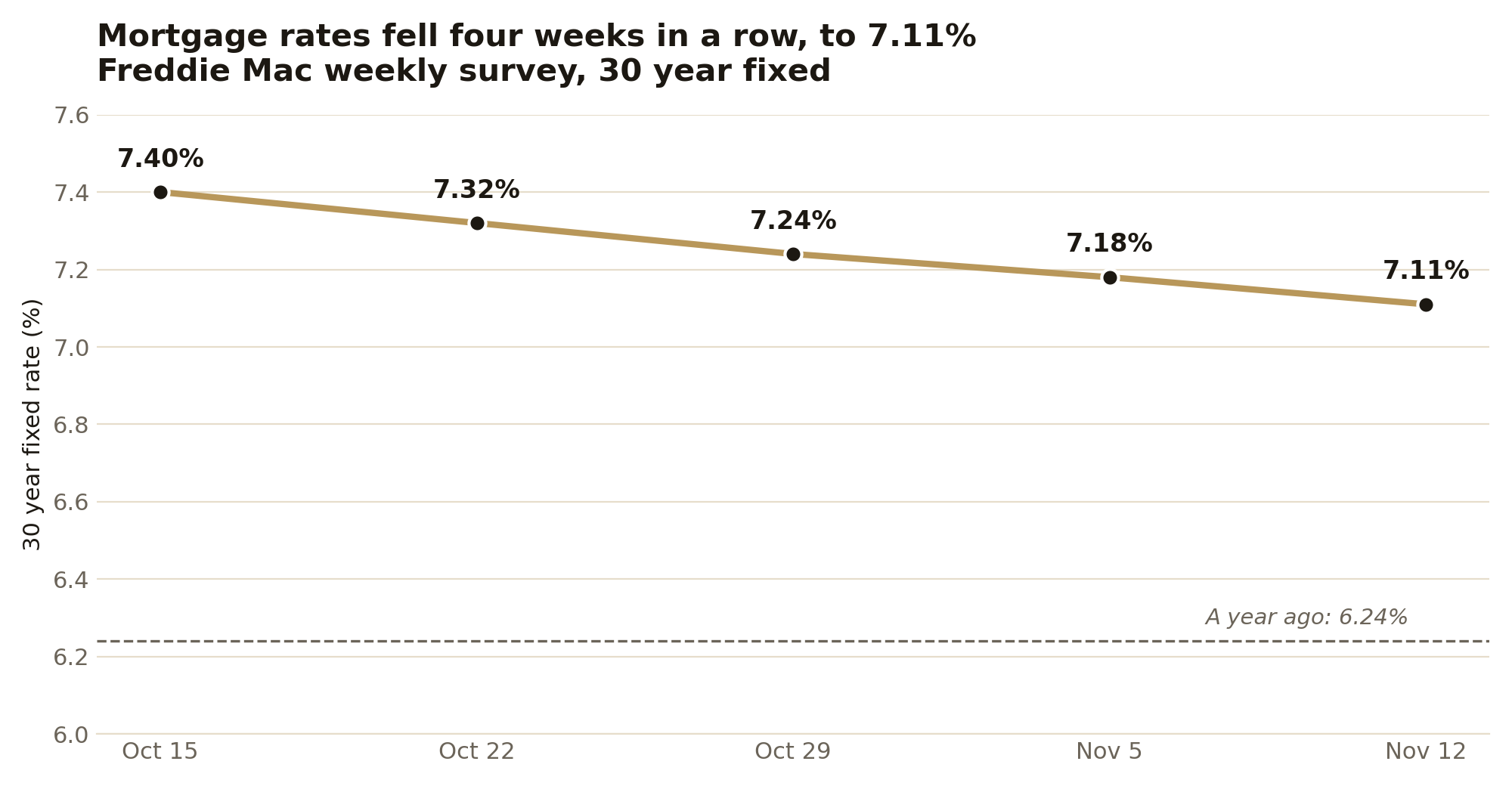
That drop is real money. On a $1,000,000 loan, 7.11 percent is about $6,727 a month in principal and interest, compared with about $6,924 at 7.40 percent. That is about $197 a month saved from the peak. On a $2,000,000 loan, the same move is about $393 a month.
Do not get comfortable with it, for two reasons.
First, the survey mostly captured the calmer start of the week, before the inflation reports landed. By Friday's close, the 10 year Treasury yield was near 5.15 percent and daily lender pricing had moved back up, with weekend sheets showing the 30 year closer to 7.50 percent.
Second, a year ago the 30 year was at 6.24 percent. Even at 7.11 percent, that same $1,000,000 loan costs about $576 a month more than it would have a year ago. That gap is the freeze.

What will the Fed do on December 9?
The Fed raised its benchmark rate in September for the first time in three years, then held it at 3.75 to 4.00 percent on October 28 in a 10 to 2 vote. The two dissenters did not want a cut. They wanted another hike.
There is no Fed meeting in November. The next decision is December 8 and 9, and it comes with new economic projections.
After this week's CPI and PPI reports, futures markets priced a December quarter point hike as near certain, at about 91 percent in the readings on November 12 and 13, which would take the target range to 4.00 to 4.25 percent. At least one Fed governor has said a half point move should be on the table if inflation keeps surprising to the upside.
A Fed hike does not set mortgage rates directly. Mortgages follow the 10 year Treasury, plus a spread. If the Fed hikes because inflation is persistent, bond investors usually demand higher yields too, and mortgage rates follow them up. If the Fed hikes and convinces markets inflation will finally fall, longer term yields can settle. Watch the reaction, not just the headline.
Three dates matter before and after the decision:
- November 18: minutes from the October Fed meeting
- November 25: the October PCE report, the Fed's preferred inflation measure
- December 4: the November jobs report
Why inventory is rising for the wrong reason
National active inventory was 895,988 homes in the week ending November 13, still up 7.11 percent from a year ago. Pending sales in that same weekly tracker ran 16.6 percent below last year, and about 43 percent of listings had taken a price cut.
Realtor.com's week ending November 7 tells you why. New listings fell 10.3 percent from a year ago, the sixth straight weekly decline, while active listings still rose 8.3 percent.
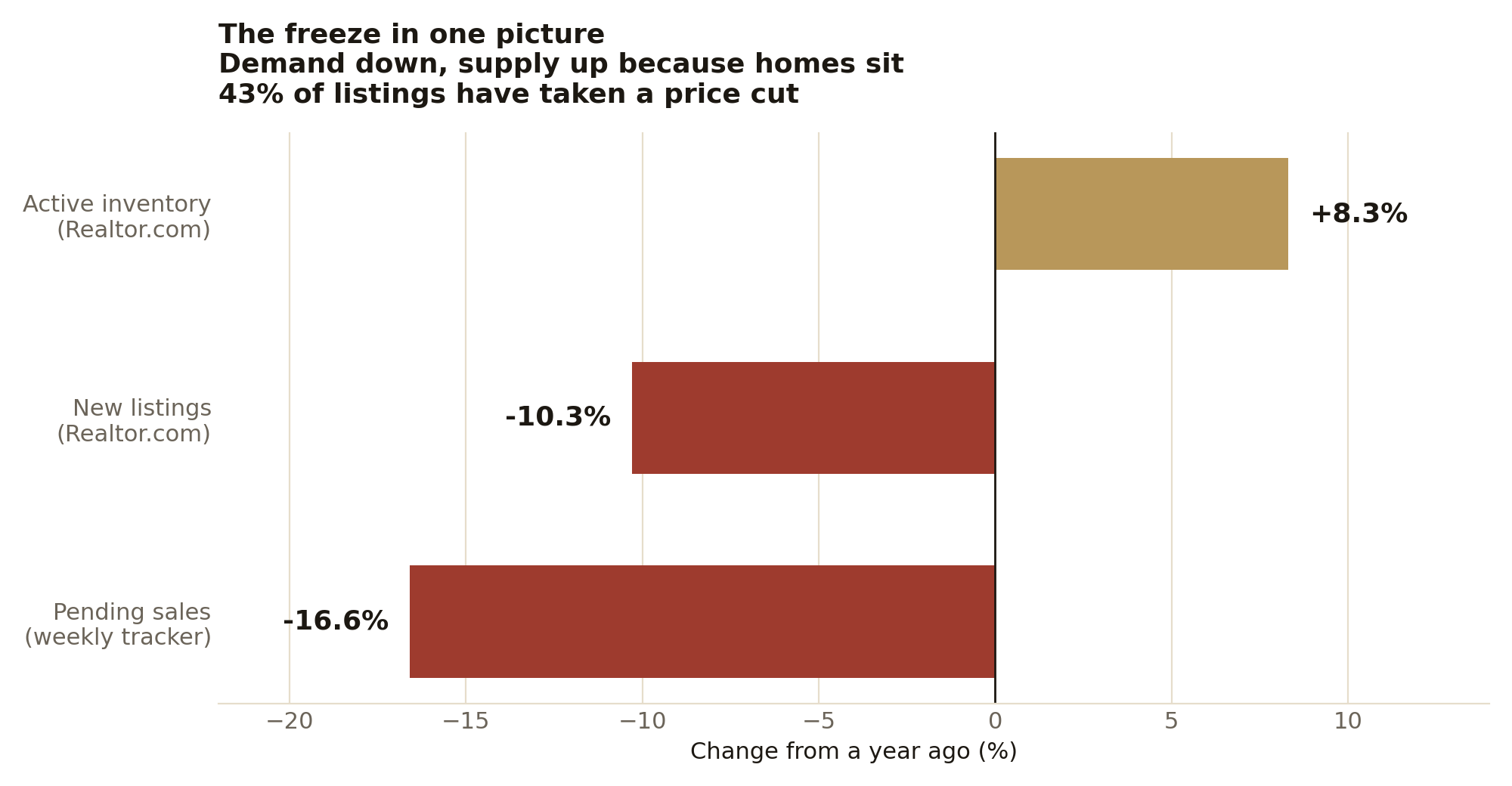
Inventory is not rising because sellers are flooding the market. It is rising because homes are sitting. That distinction matters for negotiation. A fresh, well priced listing in Calabasas or Hidden Hills is not competing with a flood. A stale, overpriced listing is competing with its own price cuts.
This is also where a real valuation matters more than a national median. The median existing home price in the United States is $416,700. That number has nothing to do with a home in Calabasas or Hidden Hills. If you're interested in what your home can fetch in today's market, click What's My Home Worth and compare your number against the last three sales near you.

What this means in luxury markets
In Calabasas, Hidden Hills, Beverly Hills, and Lake Sherwood, the same freeze shows up differently than it does nationally:
- Cash and low leverage buyers still have real power, especially on homes that have sat and taken a cut. They are not waiting on the Fed.
- Move up sellers are the locked in group. Selling is easy to picture. Giving up a low rate to take a 7 percent plus loan on the next house is the hard part, so many simply stay, which keeps good inventory off the market.
- Pricing is doing all the work. With pending sales down double digits nationally, a luxury listing priced to the last great sale will sit. A listing priced to this week's buyer pool will move, because there are so few direct competitors for the right house.
- Off market and private exclusive paths matter more in a freeze. When public days on market punish a listing, a quiet, targeted introduction can protect price while the public market sorts itself out.
That is why luxury is not crashing. The sellers who do not need to sell are not selling cheap. They are waiting, or they are selling privately, or they are pricing correctly and closing. The distress that defines a crash is at 2 percent.
If you are selling this winter
- Price to the buyer who exists in November and December 2026, not the buyer who existed in 2021. The first price is the one that creates competition.
- Do the prep before you launch. In a market where 43 percent of listings have cut, a home that looks finished and feels easy commands the premium that is still available.
- Consider timing around December 9 on purpose. If you can be live and compelling before the Fed headlines hit, you own the conversation that week. If you launch into the headline, you share it.
- Know your walk away number before you list. In a freeze, the strongest negotiation position is being genuinely willing to hold.
If you are buying this winter
- Do not wait for 5 percent. No major forecast in the current data has the 30 year near 5 percent in 2027. Waiting for a rate that is not in the forecast while the right house trades is the expensive version of patience.
- Shop the sitting listings. A home at 60 or 90 days with one or two cuts is where the negotiation lives right now, especially if your financing is clean and your close is certain.
- Lock strategy matters more than rate shopping this month. Talk to your lender now about what a December hike, and the days right after it, would do to your lock, before you are in escrow.
- Buy the house, refinance the rate later only if the math works on day one without the refinance. A purchase that only works if rates fall is not a plan.
My take
This is the most honest market we have had in years. It rewards preparation, correct pricing, and certainty, and it punishes hope as a strategy on both sides.
Sales at a 2010 low will get the headlines. The number I am watching for my clients is the combination underneath it: prices holding, distress at 2 percent, new listings falling, and 43 percent of sellers having to cut to find the market. That is a freeze that thaws house by house, not all at once.
If a move is in your plans for winter or spring, the December 9 Fed decision is your planning deadline, not your start date. Get the valuation, the prep list, and the financing conversation done now, while you can still choose your timing.
Thinking about selling, or wondering what this freeze means for your home specifically? Contact Calabasas Realtor Stephen White, Christie's International Real Estate, at 310.701.9747 for a straight read.
And if you're curious what your home is worth in today's market, click the button below and find out in about a minute.

Sources: Bureau of Labor Statistics, Consumer Price Index for October 2026, released November 10, 2026; Bureau of Labor Statistics, Producer Price Indexes for October 2026, released November 13, 2026; Bureau of Labor Statistics, Employment Situation for October 2026, released November 6, 2026; National Association of Realtors, Existing Home Sales for October 2026, released November 12, 2026; Freddie Mac, Primary Mortgage Market Survey, November 12, 2026; Federal Reserve, FOMC statement, October 28, 2026; CME FedWatch, December 2026 meeting probabilities, November 12 to 13, 2026; HousingWire weekly housing tracker using Altos Research data, week ending November 13, 2026; Realtor.com Weekly Housing Trends, week ending November 7, 2026. Mortgage payment examples are principal and interest only on a 30 year fixed loan and are for illustration, not a rate quote. This post is general information, not financial or legal advice.
Frequently asked questions
Is the luxury housing market crashing in November 2026? No. Existing home sales fell to a 3.75 million annual pace in October 2026, the lowest since August 2010, but the median price rose 0.4 percent from a year earlier to $416,700 and distressed sales were just 2 percent of transactions. That is a volume freeze driven by mortgage rates, not a price crash driven by forced selling.
What is the average 30 year mortgage rate right now? Freddie Mac's weekly survey put the 30 year fixed at 7.11 percent on November 12, 2026, down from a 7.40 percent peak on October 15, 2026. Daily lender pricing moved back up after that survey, following the October inflation reports.
Will the Fed raise rates in December 2026? Markets priced a quarter point hike at the December 8 to 9, 2026 FOMC meeting as near certain, at about 91 percent on November 12 to 13, 2026, after CPI rose 0.4 percent and producer prices rose 6.5 percent over the year. The Fed held its target range at 3.75 to 4.00 percent on October 28, 2026.
Should I wait for mortgage rates to fall before buying in Calabasas or Hidden Hills? No major forecast in the current data has the 30 year fixed near 5 percent in 2027. The stronger strategy in this market is to buy a home that works at today's rate, especially a listing that has sat and taken a price cut, rather than waiting for a rate that is not in the forecast.