By Stephen White, Luxury Estates Director, Christie's International Real Estate Southern California
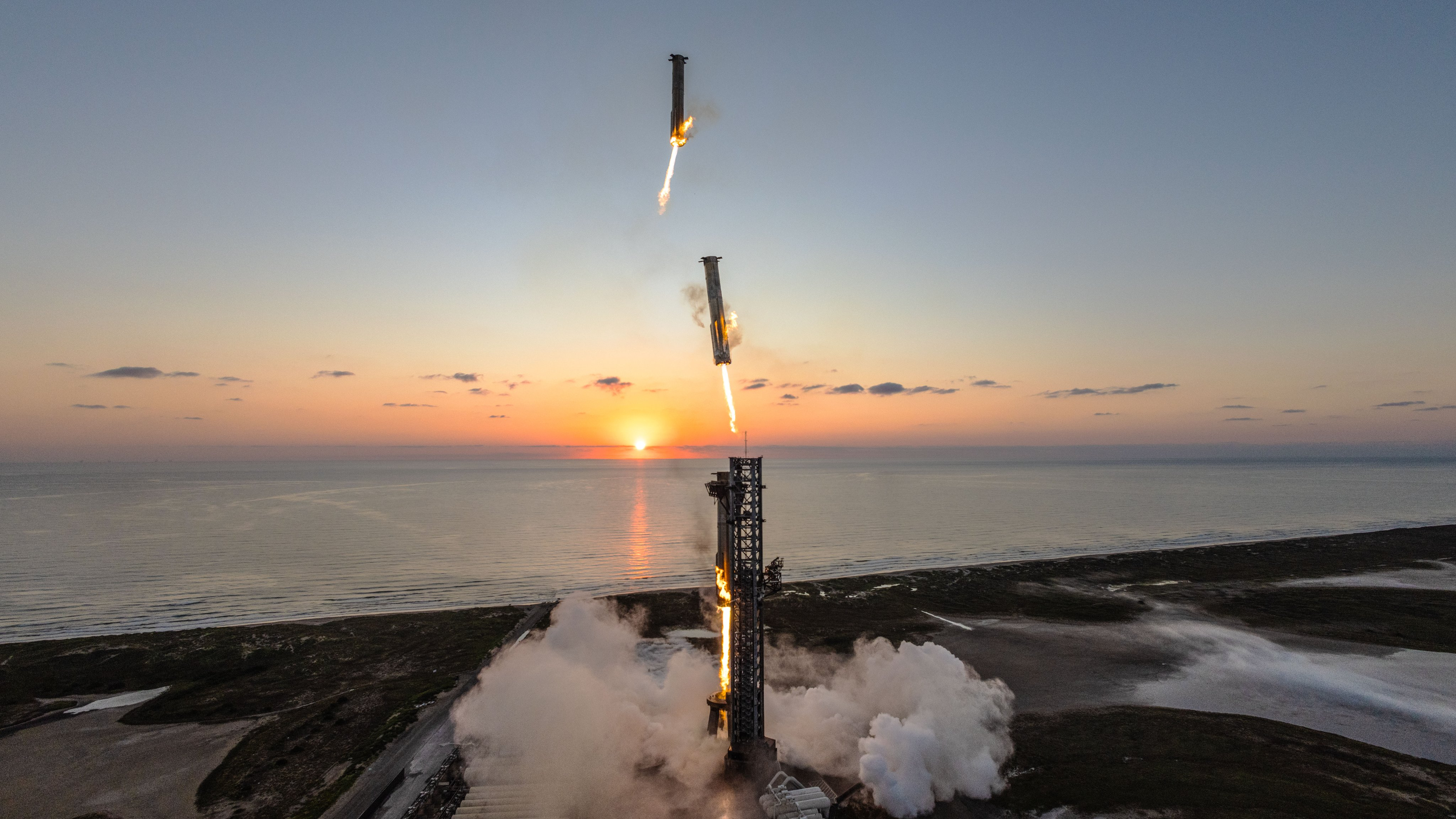
In short: SpaceX reported third quarter revenue of $14.6 billion, up 161 percent year over year, and net income of $4.4 billion. Elon Musk confirmed both companies have formed special committees to explore a merger.
At recent prices, SpaceX is worth about $2 trillion and Tesla is worth about $1.47 trillion to $1.5 trillion. Combined, that is about $3.5 trillion, which would be the largest merger in history and one of the five most valuable companies on Earth.
I believe the real estate effect would be real, local, and uneven. It would not lift every city the same way. It would hit hardest where the employees, the equity, and the constrained housing supply already are.
I read the Yahoo Finance story, "The world's super company: Wall Street weighs SpaceX earnings, company's likely Tesla tie-up", the way I read every big market story: what does this do to houses?
Wall Street is asking whether the combined company deserves the price. I am asking a different question. When trillions of dollars of paper wealth becomes real, spendable money for thousands of people in a handful of cities, where does that money go first?
History says a lot of it goes into real estate. And history gives us receipts.
What just happened, in plain numbers
Let us start with the facts, because the numbers here are large enough that people stop believing them.
- SpaceX third quarter revenue: $14.6 billion, up 161 percent from a year earlier, beating the LSEG consensus estimate of $12.72 billion, according to Reuters and CNN.
- SpaceX net income: $4.4 billion, its first profit as a public company, compared with a net loss of about $1.1 billion a year earlier. Analysts had expected closer to $1.6 billion.
- The growth engine: the Super Intelligence segment, which includes AI infrastructure, rose to $7.56 billion in revenue, and Starlink connectivity revenue rose to $5.25 billion. Starlink reached 13.6 million subscribers.
- The market reaction: SpaceX shares rose about 8 to 9 percent, Tesla rose about 1 to 2 percent, after Musk said a merger would be, in his words, "a good idea" with "a lot of merit," while stressing that shareholders must approve it and that he is recused from the committee talks as a conflicted party.
- The hurdle: a deal needs support from a majority of all outstanding Tesla shares, not just the shares that vote. Musk himself called that a high hurdle. No terms, no exchange ratio, and no agreement exist yet.
That last point matters. This is not a done deal. Anyone telling you it is certain is selling you something. What is certain is the scale, and scale is what moves housing.
What Wall Street is actually saying, from the Yahoo Finance piece
The Yahoo Finance article by Ines Ferre, published October 25, 2026, is worth reading closely, because Wall Street is no longer treating these as two separate companies. Strategists in that piece are already pricing them as one.
- Merger odds: Dan Ives of Yorkville Ives put an 80 to 90 percent chance on Tesla and SpaceX merging by the end of 2027, citing strategic AI and data reasons, with committees at both companies and Musk pushing for a deal. That is an analyst opinion, not a confirmation, but it tells you how the smart money is positioning.
- SpaceX price target: JPMorgan analyst Doug Anmuth more than doubled his SpaceX price target to $500, after the better than expected results. SpaceX was trading at about $146 to $147 on Friday, October 23. A $500 target is not a small raise. It is a statement that the market still undervalues the AI compute business.
- Tesla price target: Canaccord Genuity analyst George Gianarikas raised his Tesla target to $442 from $410, and said the call was based fundamentally on a merger. His line is the one I keep coming back to: if they merge, you are buying the future of the physical world.
- Total addressable market: Anmuth put SpaceX's combined opportunity at more than $28 trillion. SpaceX itself used a $28.5 trillion market opportunity figure at its IPO. Numbers that large stop being a market and start being an economy.
- The fifth hyperscaler argument: Futurum Group CEO Daniel Newman argued that a growing satellite business, a lucrative space business underwritten by AI profits, and a possible Tesla merger would make the combined company more than a fifth hyperscaler alongside Meta, Alphabet, Microsoft, and Amazon. RBC analyst Tom Narayan pointed to Terafab, the joint chip plant, as a way of bypassing Nvidia and TSMC on chip supply. If that works, it is huge. If it does not, it is a very expensive lesson.
- Musk's own projection: Musk projected SpaceX annual recurring revenue by the end of 2027 at somewhere between $500 billion and $1 trillion. That is a projection, not a result, and I treat it that way. The same plan calls for Tesla to produce 20,000 Optimus robots per week by the end of 2027, powered by Terafab chips, and for Terafab to cut production costs by up to 90 percent.
Notice what the Yahoo piece does not contain: a bear case. No valuation objection, no regulatory warning, no dissenting analyst. That absence is information too. When coverage gets one sided, I get more careful, not less. The section near the end of this post, on what I do not believe, is my attempt to supply the balance that piece left out.
The question everyone asked me: what would the combined company actually be worth?
Here is the math, with sources and dates, because this is the number the whole story turns on.
| Company | Value | Source and date |
|---|---|---|
| SpaceX (NASDAQ: SPCX) at IPO pricing, June 2026 | $1.75 trillion, raising about $75 billion at $135 per share | IPO reporting, June 2026 |
| SpaceX at recent market prices, October 23, 2026 | About $1.9 trillion to $2 trillion at about $147.69 per share | Motley Fool largest companies ranking, data as of October 23, 2026 |
| Tesla (NASDAQ: TSLA) at recent market prices, October 23, 2026 | About $1.47 trillion to $1.5 trillion at about $372 per share | StockAnalysis Tesla market cap history and Finnhub, October 23, 2026 |
| Combined, if merged at recent prices | About $3.4 trillion to $3.5 trillion | Simple addition of the two market values above. This is a market value estimate, not an agreed deal price. |
Put that $3.5 trillion in context. As of October 23, 2026, Nvidia and Apple were each worth about $5.1 trillion, and Alphabet and Microsoft were each worth about $3.9 trillion. A combined SpaceX and Tesla at about $3.5 trillion would sit just behind those four, ahead of Amazon at about $2.7 trillion, and it would be worth more than Tesla and SpaceX have ever been worth on their own by a wide margin.
For Tesla alone, the run is already historic. Tesla's market cap rose from $2.48 billion at the end of 2010 to $668.9 billion at the end of 2020, to $1.06 trillion at the end of 2021, and to about $1.47 trillion in October 2026. That is the kind of long compounding that created a generation of Tesla employee and investor wealth in California, Texas, and Nevada long before SpaceX went public.
My opinion: the combined value is not just a headline. A $3.5 trillion company concentrates decision making, capital spending, and employee equity in one place.
The Terafab chip plant that Tesla and SpaceX are building together in Texas, the AI data center spending that SpaceX guided at another $35 billion to $40 billion in the fourth quarter alone, and the shared work on robotics and autonomous systems all point the same direction. More payroll, more contractors, more suppliers, and more equity events in the same metro areas. That is a housing story.
Why real estate feels mergers and IPOs before almost anything else
A merger does not move home prices because of a press release. It moves home prices through three concrete channels, and I have watched all three work in California.
1. Liquidity. Stock that could not be spent becomes stock that can. The SpaceX IPO in June 2026 is the clearest example in history.
An analysis by investment platform Hill, reported by the New York Times and People, estimated that more than 4,400 current and former SpaceX employees became millionaires at the IPO price, and about 400 of them held stakes worth $100 million or more. Redfin estimated that SpaceX employees collectively hold enough wealth to buy roughly 5 percent of all homes in the Los Angeles metro area. Read that again. Five percent of a metro with almost no spare inventory.
2. Payroll and proximity. People buy near work, near good schools, and near the life they want. SpaceX still employs 7,661 people in Hawthorne, California, according to the city's annual report, even after the headquarters moved to Starbase, Texas. Tesla employs tens of thousands across Fremont, Austin, and Sparks, Nevada. A combined company that is hiring for AI, chips, and robotics does not spread those jobs evenly across America. It clusters them.
3. Confidence and the wealth effect. When your neighbor's equity doubles, sellers hold firmer, buyers move faster, and off-market conversations start. Rice University research on IPOs found that the listing event itself, not just the capital raised, lifts local jobs, business formation, consumer spending, and real estate values near a company.
None of this guarantees a boom. It does mean the demand shock is measurable, dated, and concentrated. As an agent, that is exactly the kind of shock I price for.
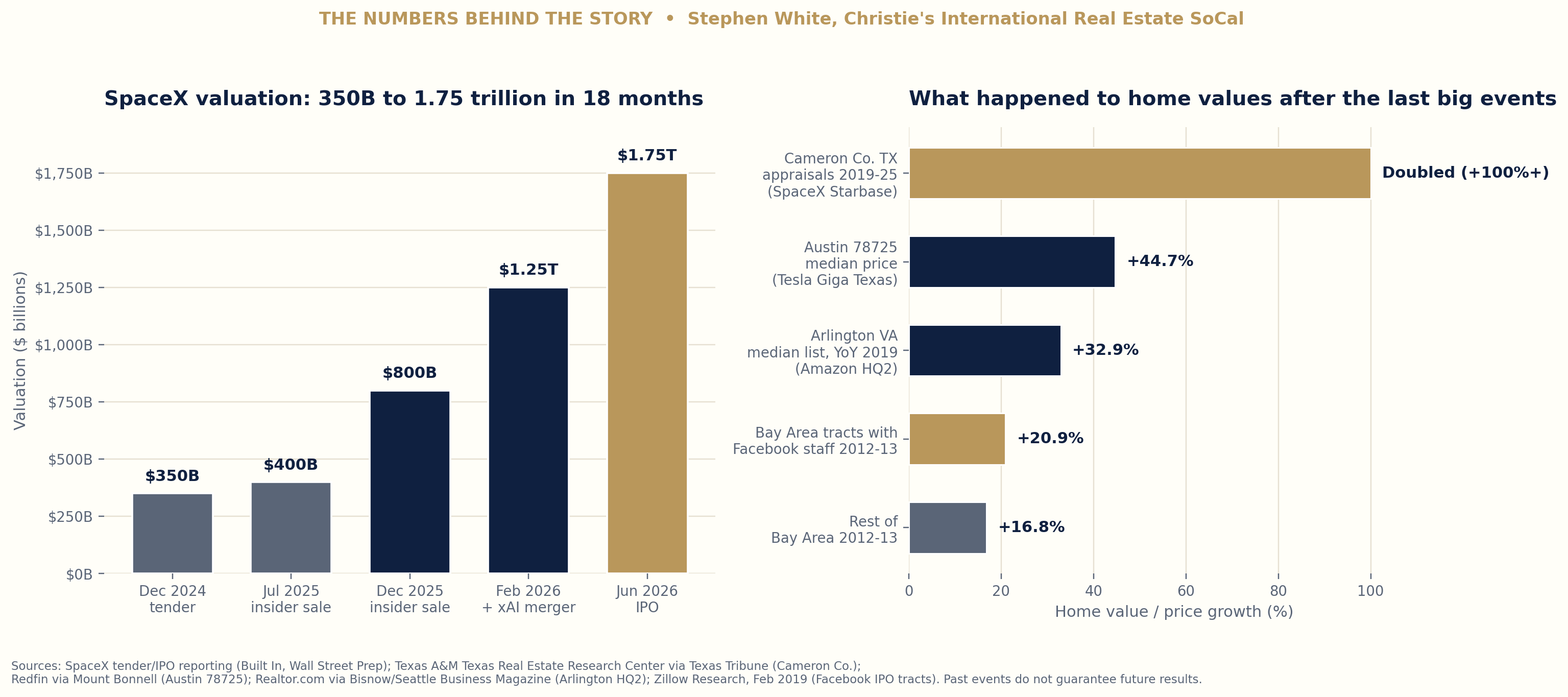 SpaceX valuation rose from $350 billion in December 2024 to $1.75 trillion at its June 2026 IPO. On the right, what happened to home values after the last four comparable corporate events. Sources are listed on the chart. Past events do not guarantee future results.
The receipts: what actually happened last time, four times over
I do not deal in vibes. Here is what the data shows from the closest precedents we have.
Facebook IPO, Bay Area, 2012 to 2013. Zillow Research found that home values in census tracts where likely Facebook employees lived rose 20.9 percent from March 2012 to March 2013, compared with 16.8 percent for the rest of the Bay Area.
That extra growth was worth about $29,800 in additional appreciation in one year, and every 10 Facebook employees in a tract added about 1.6 percentage points of growth. Facebook created about 1,000 new millionaires. SpaceX created more than four times that many, at a far larger valuation.
Amazon HQ2, Arlington, Virginia, 2018 to 2019. Realtor.com reported that Arlington's median list price rose to $863,000 in October 2019, up 32.9 percent year over year, after the HQ2 announcement in November 2018.
In a separate cut, the median rose from $640,000 to $750,000 by April 2019, up 17.3 percent, while the national median rose just 5.5 percent. Inventory in Arlington fell by almost half. Half the homes sold in under 28 days. That is what a credible promise of high wage jobs does to a supply constrained market, even before most of those jobs arrive.
Tesla Giga Texas, Austin, 2020 to today. Redfin data reported for ZIP code 78725, home to Giga Texas, showed the median sale price surging 44.7 percent.
The plant has employed an estimated 12,000 to more than 20,000 people at different points in its ramp, with a reported regional economic impact in the tens of billions. I will add the honest caveat that later reporting noted: Tesla's Austin headcount fell by about 22 percent between the end of 2024 and the end of 2025. Anchor employer markets rise faster, and they correct harder when the anchor trims. Both halves of that sentence are true.
SpaceX Starbase, Cameron County, Texas, 2019 to 2025. This is the most direct precedent, because it is SpaceX itself. Research from the Texas Real Estate Research Center at Texas A&M University, reported by the Texas Tribune, found that the median property appraisal value in Cameron County more than doubled from 2019 to 2025, faster than the statewide median, and the median property tax bill rose 57 percent, compared with 42 percent statewide.
After the IPO, local agents described SpaceX coworkers bidding against each other, sight unseen cash offers, and land that could not be given away five years earlier suddenly trading. A Texas A&M economist also gave the balanced warning I agree with: Brownsville has land to build on, so supply can respond in a way Silicon Valley never could, and rising values help owners while squeezing residents whose incomes do not rise with them.
The pattern across all four is consistent. The announcement moves expectations. The liquidity moves buyers. The payroll sustains it. And inventory decides whether you get steady growth or a spike.
City by city: where I believe a $3.5 trillion merger would be felt most
Los Angeles and the South Bay, California: the biggest luxury effect. This is my market, and I believe it is the most underestimated part of the national story. The headquarters plaque moved to Texas. A huge share of the equity did not.
With 7,661 SpaceX employees in Hawthorne, plus Tesla's deep California footprint, Los Angeles holds the largest concentration of newly liquid SpaceX wealth in the country. The Los Angeles Times reported agents from Hawthorne to Manhattan Beach, Venice, and Santa Monica seeing early inquiries on $5 million plus properties after the IPO.
I believe a merger that pushes the combined value toward $3.5 trillion, and pushes more vesting and more hiring with it, tightens the top of the South Bay and Westside first: Manhattan Beach, Hermosa Beach, El Segundo, Venice, Santa Monica, and then the move-up markets behind them.
In my own backyard of Calabasas and Hidden Hills, the effect is second order but real. Tech and aerospace equity buyers have always been part of our buyer pool, and a fresh liquidity wave adds bidders to a market that already runs on low inventory.
Sellers here do not need to chase the headline. They need to be ready before the lockup and vesting calendar turns inquiries into offers. If you are wondering what that timing means for your home, start with a real home valuation and a conversation, not a guess.
Austin, Texas: the payroll capital of a combined company. Austin already lived the Tesla effect once, with a 44.7 percent median jump in the Giga Texas ZIP code. A merger formalizes what is already happening on the ground: Terafab chip production, battery work, AI infrastructure, and the Boring Company presence, all in Central Texas.
I believe Austin sees the broadest middle market effect of any city on this list, from Manor and Pflugerville family homes to luxury in West Lake Hills and central Austin. The risk is also Austin sized. This city has already shown it will build, and it has already shown it will correct when hiring slows. Buy for the long hold here, not for the headline quarter.
Brownsville and Starbase, Texas: the highest percentage upside, and the sharpest affordability question. Cameron County values already doubled once on SpaceX alone.
An incorporated Starbase, a combined company guiding tens of billions in new spending, and thousands of millionaire employees in a historically lower cost county is the strongest percentage growth setup in America. It is also the place where displacement risk is most real, exactly as Texas A&M researchers warned. My belief: land and well located single family homes near Starbase and in Brownsville keep appreciating, builders keep coming, and local policy on taxes and supply becomes the whole ballgame.
Seattle and Redmond, Washington: the quiet Starlink effect. Starlink engineering has deep roots in Redmond. A combined company that leans harder into connectivity and AI keeps high wage hiring in the Seattle metro, a market that already learned the Amazon lesson about equity wealth and housing. I expect a steadier, premium segment effect here rather than a spike: Eastside luxury and close-in Seattle homes benefit first.
Bay Area and Fremont, California: Tesla's original wealth engine. Fremont is Tesla's longest running American plant, and the Bay Area is where the Facebook IPO data was written.
Bay Area buyers already use stock for down payments at the highest rates in the nation. Zillow found 36.3 percent of San Francisco buyers used investments or stocks to fund a down payment, compared with a 26.3 percent national average. Fresh SpaceX and Tesla liquidity does not need to teach this market a new habit. It just funds the existing one.
Florida Space Coast: Cape Canaveral, Merritt Island, and Melbourne. Launch operations mean engineers, technicians, and contractors in Brevard County. Space Coast housing has historically moved in steps with launch cadence and major program wins. A combined company spending at this scale supports continued demand there, especially for waterfront and newer construction that coastal supply cannot easily replace.
New York and Washington, DC: the finance and policy effect. New York does not build rockets, but it underwrites them, trades them, and advises on them. The largest merger in history generates fees, bonuses, and legal and banking payroll that show up in Tri-State housing the way Wall Street compensation always has.
Washington matters for a different reason. A $3.5 trillion combination of cars, rockets, satellites, and AI will draw serious regulatory and antitrust attention. Arlington already proved with HQ2 how fast expectations alone can move a market by 32.9 percent. Policy proximity is its own industry, and it buys houses.
What I do not believe
A good opinion piece should tell you where the opinion stops.
I do not believe a merger announcement makes every home in America worth more. Most cities have no SpaceX or Tesla payroll, no equity holders, and no reason to move.
I do not believe the $3.5 trillion figure is a promise. Morningstar valued SpaceX at about $780 billion in its discounted cash flow work during the IPO period, far below the market price, and SpaceX lost $4.9 billion in 2025 before this year's swing to profit.
The combined company would carry enormous capital spending. If the stock falls, the housing effect shrinks with it. Wealth effects run in both directions. We saw that when Tesla's market cap fell from $1.06 trillion at the end of 2021 to $389 billion at the end of 2022.
I do not believe timing is immediate. Lockups, vesting schedules, tax planning, and the shareholder vote itself all sit between a headline and a home purchase. The Facebook data showed the strongest housing effect in the months after lockups expired, not on IPO day.
And I do not believe interest rates stop mattering. A liquidity rich buyer still does arithmetic. What changes is that more of these buyers can pay cash, shorten contingencies, or absorb a rate that stops a financed buyer cold. In a tight market, that difference wins houses.
My bottom line, and what I would do with it
I believe a SpaceX and Tesla merger, if shareholders approve it, creates a $3.5 trillion company whose wealth, payroll, and spending are concentrated in a small number of American metros, and that housing in those metros, especially at the luxury end in Los Angeles, will feel it in inquiries first, then in offers, then in comparable sales.
If you are a seller in Los Angeles, Austin, the Space Coast, or South Texas, my advice is to get your pricing and preparation work done early, before the vesting calendar does your marketing for you. The Arlington lesson is that the announcement window itself reprices a market.
If you are a buyer in those cities, my advice is the opposite of panic. Buy the house you would want if no merger ever happened, in the location that holds value when an employer trims headcount, the way Austin reminded everyone it can. Use the window before liquidity fully lands, not after.
If you are an investor, follow the supply, not the slogan. Cameron County can build. Manhattan Beach cannot. That single difference explains more about future returns than any stock chart.
Real estate has always been a local business priced by national money. A $3.5 trillion super company is national money at a scale we have never seen. The cities that house its people will price that in. They already are.
Thinking about what your home is worth in this market, or whether to buy before the next liquidity wave lands? Contact Calabasas Realtor Stephen White, Christie's International Real Estate, at 310.701.9747, or visit White Luxury Homes for my latest market breakdowns, including my recent work on mortgage rates, luxury pricing, and Los Angeles market shifts.
Get the next market breakdown first
Weekly luxury market notes for Calabasas, Hidden Hills, and the Westside. No spam, unsubscribe anytime.
Stephen White
Luxury Estates Director, Christie’s International Real Estate Southern California
I help luxury buyers and sellers across Calabasas, Hidden Hills, and greater Los Angeles make their move with confidence, backed by Christie’s International Real Estate Southern California.
310.701.9747 | [email protected] | whiteluxuryhomes.com
DRE 02009880 | Brokerage DRE 01527644
Frequently asked questions
What would Tesla and SpaceX be worth if they merge? At recent market prices in late October 2026, SpaceX was worth about $1.9 trillion to $2 trillion and Tesla was worth about $1.47 trillion to $1.5 trillion. Added together, a combined company would be worth about $3.4 trillion to $3.5 trillion. That is an estimate based on current market values, not an agreed merger price, and it would change with both stocks.
Would a SpaceX and Tesla merger be the largest merger ever? Yes, at about $3.5 trillion in combined market value, it would be the largest corporate combination in history by a wide margin, and the combined company would rank among the five most valuable companies in the world, behind Nvidia, Apple, Alphabet, and Microsoft at October 2026 values.
Is the SpaceX and Tesla merger certain to happen? No. Both companies have formed special committees, Elon Musk has recused himself as a conflicted party, no terms have been agreed, and the deal requires support from a majority of all outstanding Tesla shares. Musk has said he favors the combination and also that approval is a high hurdle.
As a measure of Wall Street sentiment, analyst Dan Ives put an 80 to 90 percent probability on a merger by the end of 2027. That is an opinion, not a guarantee.
What price targets have analysts set for SpaceX and Tesla? After SpaceX's third quarter results, JPMorgan analyst Doug Anmuth more than doubled his SpaceX price target to $500, compared with a trading price of about $146 to $147 on October 23, 2026. Canaccord Genuity analyst George Gianarikas raised his Tesla target to $442 from $410, based fundamentally on a merger. Price targets are analyst opinions and change frequently.
How did SpaceX do in its latest earnings? In the third quarter of 2026, SpaceX reported revenue of $14.6 billion, up 161 percent year over year, and net income of $4.4 billion, its first profit as a public company. Growth was led by its Super Intelligence AI segment at $7.56 billion and Starlink connectivity at $5.25 billion, with Starlink reaching 13.6 million subscribers.
How does an IPO or merger affect local home prices? It turns employee stock into spendable money, adds high wage payroll, and raises buyer confidence in specific metros. After Facebook's IPO, home values in Bay Area tracts with many Facebook employees rose 20.9 percent in a year, compared with 16.8 percent elsewhere in the region, according to Zillow. After Amazon chose Arlington for HQ2, the median list price there rose 32.9 percent in a year, according to Realtor.com.
Which cities would be most affected by a SpaceX and Tesla merger? Los Angeles and the South Bay (Hawthorne), Austin, Brownsville and Starbase, Seattle and Redmond, the Bay Area and Fremont, and the Florida Space Coast have the largest concentrations of SpaceX and Tesla employees, operations, and equity holders, so they would be expected to feel the strongest housing effects.
How many SpaceX employees became millionaires in the IPO? An analysis by investment platform Hill, reported by the New York Times, estimated more than 4,400 current and former SpaceX employees became millionaires at the June 2026 IPO price, with about 400 holding stakes worth $100 million or more.
Sources
- Yahoo Finance, Ines Ferre, "The world's super company: Wall Street weighs SpaceX earnings, company's likely Tesla tie-up," October 25, 2026. Analysts cited: Dan Ives (Yorkville Ives), Doug Anmuth (JPMorgan), George Gianarikas (Canaccord Genuity), Tom Narayan (RBC Capital Markets), Daniel Newman (Futurum Group). https://finance.yahoo.com/markets/stocks/article/the-worlds-super-company-wall-street-weighs-spacex-earnings-companys-likely-tesla-tie-up-173949705.html
- Reuters, "Tesla-SpaceX deal: Wall St says inevitable but Musk says it's not certain," October 21, 2026.
- CNN, "SpaceX stock surges after Musk says a merger with Tesla would be 'a good idea'," October 2026.
- Zillow Research, "Home-Value Surge After Facebook IPO Provides Insight For 2019," February 5, 2019.
- Realtor.com data reported by Bisnow and Seattle Business Magazine on Arlington, Virginia, October and November 2019.
- Texas Real Estate Research Center at Texas A&M University analysis of Cameron County, reported by the Texas Tribune and the Rio Grande Valley Business Journal, 2026.
- Redfin data on ZIP code 78725 and Giga Texas, reported by Mount Bonnell.
- Motley Fool, largest companies by market cap, data as of October 23, 2026. SpaceX $1.9 trillion, Tesla $1.5 trillion, Nvidia $5.1 trillion, Apple $5.1 trillion, Alphabet $3.9 trillion, Microsoft $3.9 trillion.
- StockAnalysis, Tesla market cap history, 2010 to October 23, 2026.
This post is Stephen White's opinion and market commentary. It is not investment advice, and past corporate events do not guarantee future home price results. Market values cited are as of the dates noted and change daily.