
Something unusual is happening at the top of the Los Angeles market: sellers are blinking.
Angelina Jolie just sold her historic Los Feliz estate for $24.75 million, roughly $5 million under its asking price, in a deal that closed September 24 (USA Today, Sep 24, 2026). Days earlier, a Malibu estate at 6825 Zumirez Drive closed at $28.1 million, almost exactly half of its original $56 million ask from 2022 (The Real Deal, Sep 21, 2026).
And Lindsey Vonn just cut her Beverly Hills home to $3.895 million, a $555,000 reduction from its original asking price (U.S. Sun, Sep 24, 2026).
These are not distress sales. They are a signal. When even trophy properties take discounts, pricing power has shifted to buyers. If you are thinking of selling a luxury home in the next six to twelve months, how you price a luxury home matters more than it has in years. Here is what the data says, and the framework I walk my sellers through before we ever go live.
To price a luxury home when buyers have the leverage, price against current comparable sales instead of past highs, launch in the first three to four weeks when demand peaks, and present flawlessly on day one. The data backs this up: in July 2026, 59.2% of U.S. homes sold below their original asking price, and listings that cut their price sat for a median of 60 days versus 18 for those priced right from the start (Redfin; ActiveRain).
Last updated: September 27, 2026
What does the data say about the LA market right now?
Start with the broad picture. In LA County, 30% of active listings have taken price decreases, with a median list price of $1,228,400 and a median 63 days on market (Altos Research, week ending Sep 24, 2026). Realtor.com classifies LA County as a balanced market, with 54 median days on market and a 100% sale-to-list ratio (Realtor.com, September 2026).
Now compare that to the country as a whole: 20.8% of U.S. listings had price drops in the four weeks ending September 13, up from 19.7% a year earlier (Redfin weekly housing data, via Mortgage Professional America, Sep 22, 2026). LA sellers are cutting prices at a meaningfully faster rate than the national average. Buyers here have more leverage than in most markets.
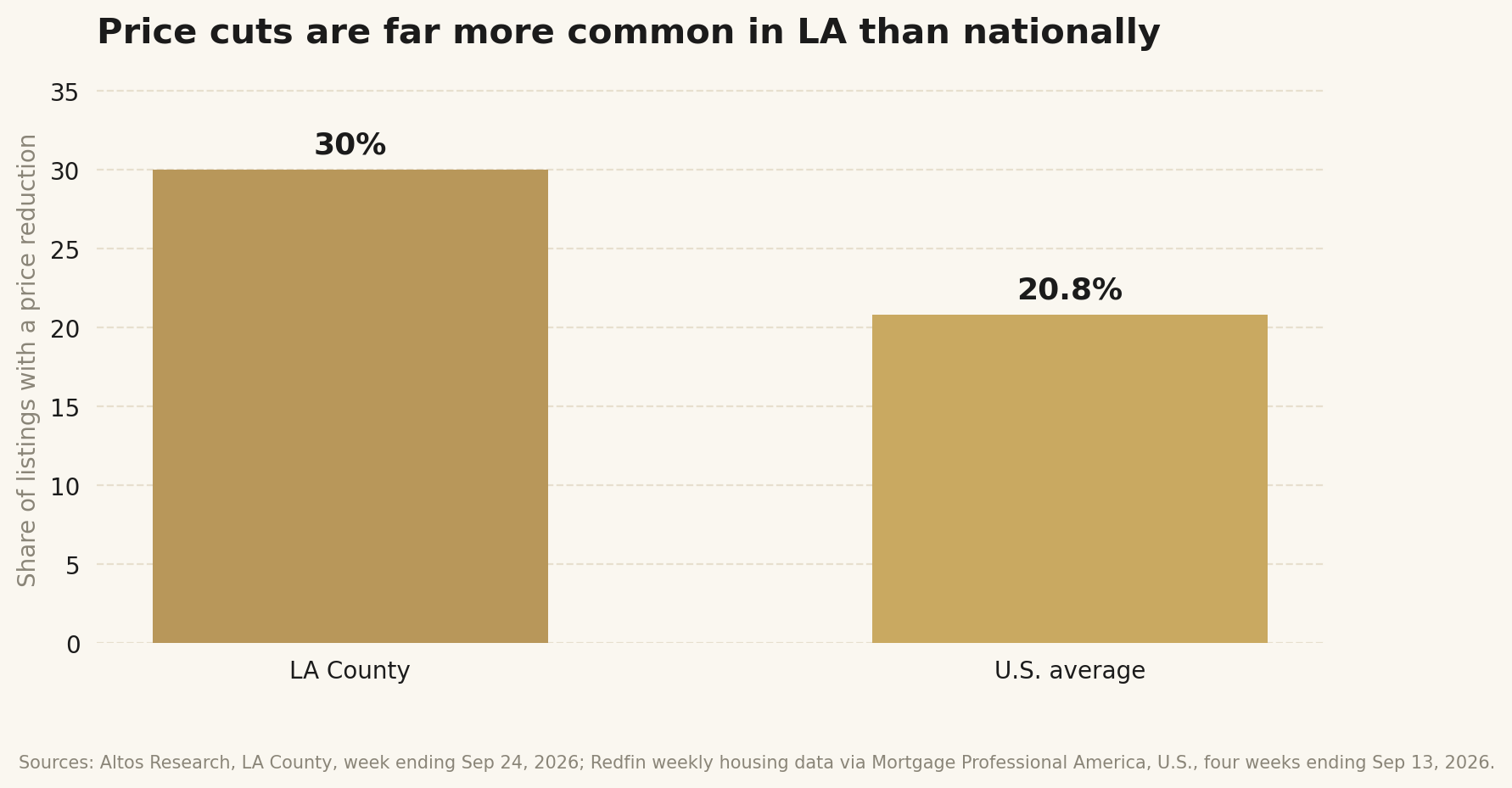 Sources: Altos Research, LA County, week ending Sep 24, 2026; Redfin weekly housing data via Mortgage Professional America, U.S., four weeks ending Sep 13, 2026.
It gets more pointed in my own backyard. In Calabasas, 38% of listings have taken price decreases, the median list price sits at $2,899,500, and the median days on market is 95, with the market tilting toward a slight buyer's advantage (Altos Research, Sep 25, 2026).
And the financing backdrop explains part of it. The 30-year fixed mortgage averaged 7.03% for the week ending September 24, up from 6.95% the prior week, the first time above 7% since January 2025 (Freddie Mac Primary Mortgage Market Survey, Sep 24, 2026). Higher rates shrink the pool of qualified buyers at every price point, and in luxury, where the buyer pool is already small, that leverage shift hits harder.
Why does overpricing cost luxury sellers more in the end?
Here is the trap I see sellers fall into: they list high to "test the market," planning to cut later if needed. The data says that strategy backfires.
In July 2026, 59.2% of U.S. homes sold below their original list price, and the average sale closed at just 96.5% of the original asking price, versus roughly 98.7% of the final asking price (Redfin monthly housing data, published Aug 2026). The gap between those two numbers is the market-wide cost of overpricing first and cutting later. On a $4 million home, a 3.5% shortfall is $140,000 left on the table.
An analysis of 20,928 residential sales found the same pattern in starker terms. Listings that never cut their price sold in a median of 18 days. Listings that cut sat for a median of 60 days, and the reduced group closed at a median of just 93% of their original asking price. For price cuts of 10% or more, the median sale was only 84.5% of the original ask (ActiveRain analysis, Sep 22, 2026).
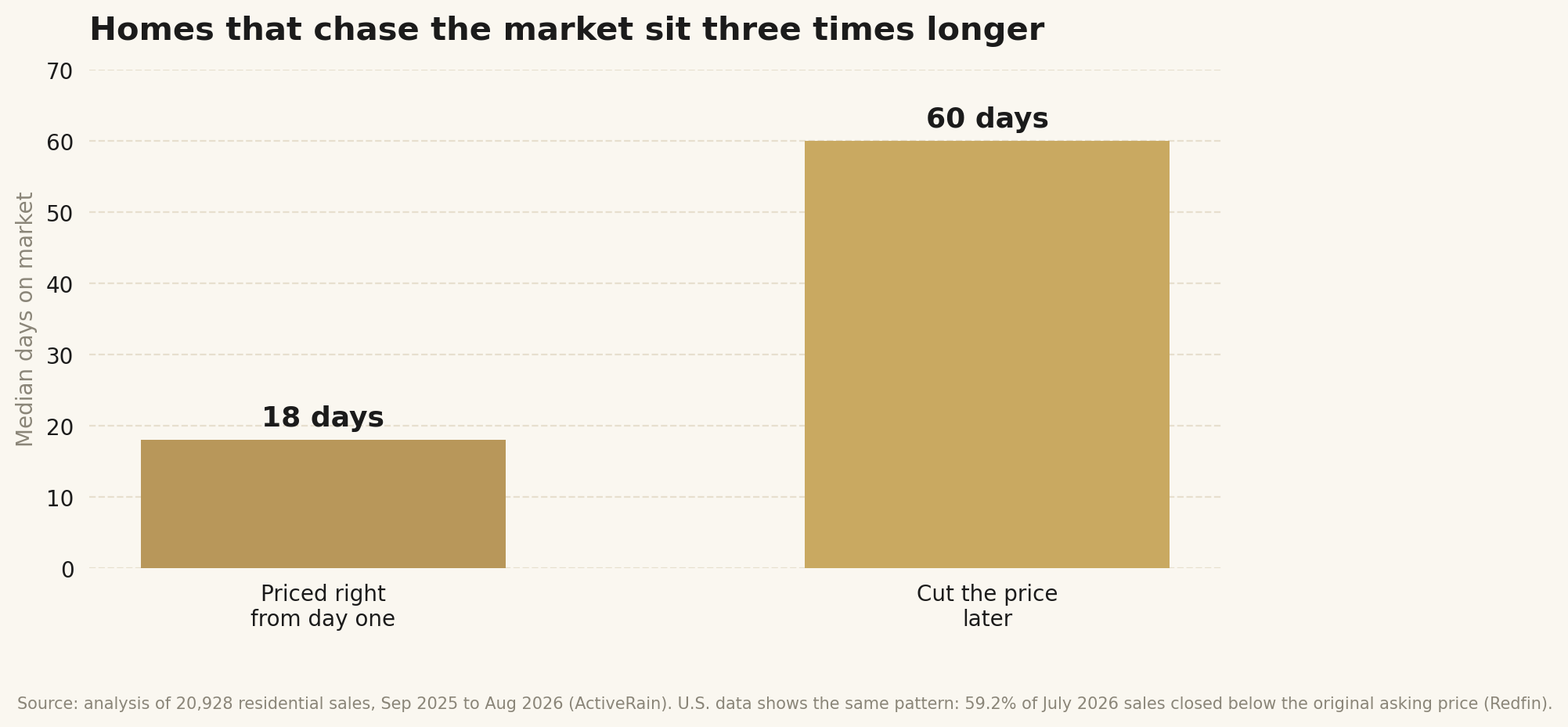 Source: analysis of 20,928 residential sales, Sep 2025 to Aug 2026 (ActiveRain). U.S. data shows the same pattern: 59.2% of July 2026 sales closed below the original asking price (Redfin).
Why does this happen? Because buyers read the story a stale listing tells. A home that sits for 90 days and takes two cuts stops looking like an opportunity and starts looking like a problem. Buyers wonder what is wrong with it, agents warn their clients about it, and offers come in lower than they would have on day one. In luxury, where every buyer has an advisor running the numbers, that perception discount is real money.
How should you price a luxury home when buyers have the leverage?
This is the framework I use with my sellers. It has five parts: positioning, timing, presentation, a plan for week three, and micro-market knowledge.
- Position against the competition, not your memories. Your price should be set against the five to seven best comparable active and pending sales, not what the neighbor got in 2022 or what you put into the renovation. Buyers are comparing your home to what else they can buy today. In the trophy tier, precision matters even more, because each comparable carries enormous weight. I wrote about that discipline in my Seller's Playbook for Beverly Hills trophy properties.
- Time the market, don't test it. The first three to four weeks carry the most qualified traffic a listing will ever see. Price to capture that wave, not to leave room for negotiation. A home that draws three strong showings in week one is worth more than a home that draws one curious buyer in week nine. When the broader market is balanced rather than hot, that early window is everything. My Agoura Hills balanced-market playbook walks through exactly how this works when neither side dominates.
- Present like the price is justified. Staging, photography, pre-inspections, and a home that shows flawlessly on day one. A $4 million buyer expects the home to feel worth $4 million the moment they walk in. Preparation is a pricing strategy, not just a cosmetic one.
- Build your week-three plan before you list. Decide in advance what a price adjustment looks like and when it happens, so a cut is strategy instead of panic. If showings are strong but offers are soft, that tells you one thing. If showings are thin from the start, that tells you another. Agree on the triggers with your agent on day one.
- Know your micro-market. Calabasas, Hidden Hills, Beverly Hills, and the Westside do not move in lockstep. Calabasas is showing a slight buyer's advantage right now while the county overall reads as balanced. That difference changes the pricing conversation completely. I track Hidden Hills closely for the same reason, and you can see how buyer-leaning conditions change the math in my Hidden Hills home value breakdown.
 Photo: Pexels / Rana Matloob Hussain
What should Calabasas and Westside sellers do right now?
Be honest about the market you are in, not the one from two years ago. With 38% of Calabasas listings taking cuts and a median 95 days on market, pricing ahead of the market beats chasing it down. The sellers winning right now are the ones who price to the current comparable sales, present flawlessly, and capture the early demand wave.
If you are considering a sale in the next year, start with a real pricing conversation, not an automated estimate. I will walk your home, study the comparable sales, and give you an honest number plus a plan to defend it. Call or text me at 310.701.9747 for a pricing consultation on how to price your luxury home.
Stephen White is the Luxury Estates Director at Christie's International Real Estate Southern California, based in Calabasas, with about 20 years of experience and $128M in career sales.